
The Interreg programs aim to promote territorial cooperation between regions and countries to contribute to their economic and social development and to face the obstacle of borders. The new Interreg 2021-2027 has a total budget of 10,000 million euros for the period 2021-2027. The individual programs are being approved by the European Commission, which is why new calls and new projects are progressively financed.
Program Objectives
A more competitive and intelligent Europe
A greener, low carbon Europe in transition to a resilient net zero carbon economy
A more connected Europe
A more social and inclusive Europe
A Europe closer to the citizens
Better governance of cooperation
A safer and more secure Europe
The 100 programs are organized into 4 levels or “chapters” of the Interreg programmes:
CROSS-BORDER
With a budget of €6.5 billion over 7 years, there are 73 different programs to ensure that cross-border obstacles and challenges are addressed within and at the external borders of the EU, i.e.:
- 49 programs within the EU-27 across its internal borders
- 10 Interreg IPA (Instrument for Pre-Accession Assistance) programs operating on the EU border with Turkey, Albania, Montenegro, Serbia and the Republic of North Macedonia.
- 14 Interreg NEXT programmes, applied at the borders with the neighboring countries (ENI) of the EU, namely: Algeria, Armenia, Azerbaijan, Egypt, Georgia, Israel, Jordan, Kyrgyz Republic, Lebanon, Libya, Moldova, Morocco, Palestine, Syria, Tunisia and Ukraine (cooperation with Belarus and Russia has been suspended)
- The PEACE+ program between the border counties of Ireland and Northern Ireland.
TRANS-NATIONAL
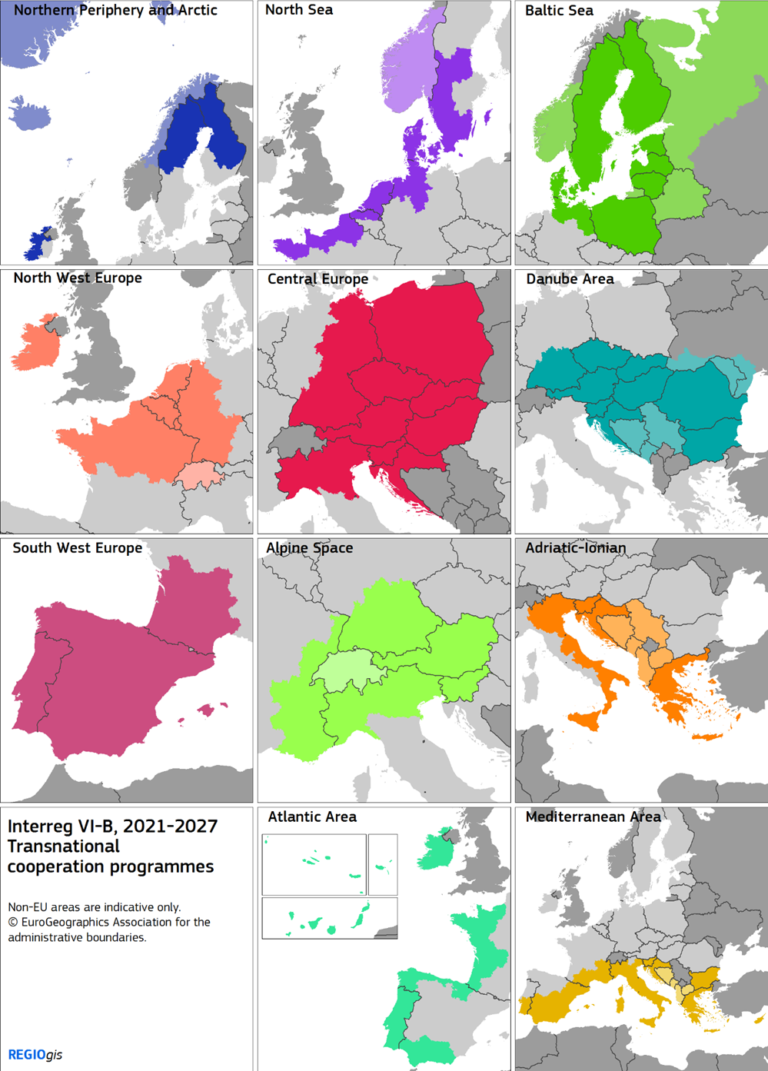
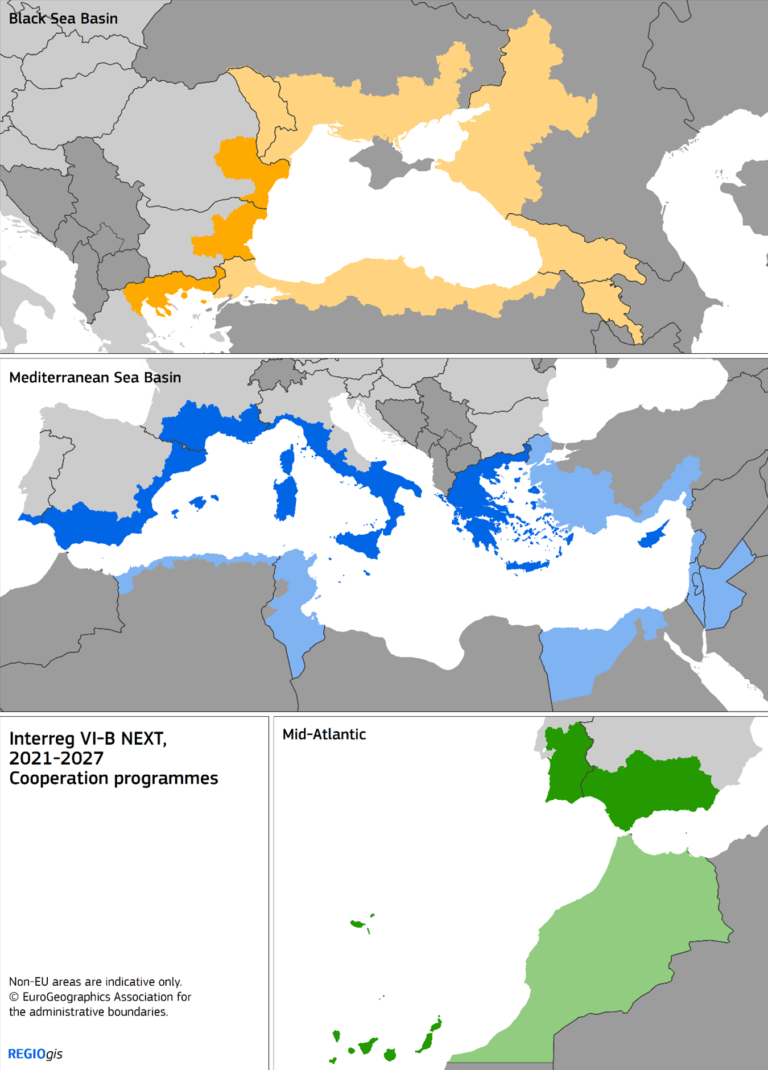
This strand allows for cooperation over larger transnational territories or around sea basins. The total budget is 1.5 billion Euros between 2021 and 2027, you can see in the picture below the 14 various Trans-national Interreg co-operation programmes:
INTERREGIONAL
It aims at boosting the effectiveness of cohesion policy by promoting exchange of experiences, innovative approaches, and capacity building between regions, 550 million Euro budget has been allocated to interregional cooperation. There are four interregional cooperation programmes within this strand:
- Interreg Europe, aiming to share innovative and sustainable solutions to regional development challenges.
- Interact, which helps cooperation among Interreg programmes
- URBACT, the programme helps cities to develop an integrated set of actions for sustainable change
- ESPON, works on policies for territorial cohesion.
INTERREGIONAL
This 4th strand which has a 208-million-euro budget covers the following Outermost regions:
- Amazonia, Caribbean,
- Middle Atlantic/Gulf of Guinea (MAC),
- Indian Ocean,
- Mozambique Channel
Scope: Europe
Budget: 550.000.000€
Application deadline: Calls will be open until 2027
Agency: European Comission
Project nature: R&D
FIND OUT WHAT THEY SAY ABOUT OUR WORK
BENEFICIARY
All types of companies in the member countries of the interregional projectss
TYPE AND AMMOUNT OF FINANCING
Variable
FINANCIAL EXPENSES
Direct and indirect expenses related to projects
RELATED NEWS
Coordinating EU collaborative projects
Coordinating EU collaborative projects: when execution marks the difference Lucía Duque Teva( Project Manager European Funds )Settings Coordinating a European collaborative project goes far beyond convening meetings or collecting deliverables….
The vision of the EAIC on the future European budget
The vision of the EAIC on the future European budget Marie Latour( European Affairs Director )Actualmente, como Director de Asuntos Europeos en Euro-Funding, cuento con más de 14 años de…
OTHER EU CALLS
EIC STEP Scale Up
El programa EIC STEP Scale Up forma parte de la Plataforma de Tecnologías Estratégicas para Europa (STEP) y ofrece apoyo financiero en forma de inversiones a empresas emergentes, pymes y pequeñas empresas con un capital medio, entre 10 y 30 millones de euros. EIC STEP Scale Up catalizará rondas de financiación mayores, amplificando así el impacto de la inversión inicial.
Women Tech EU
It has now become a fully-fledged cascade funding project that is run by an EU-wide consortium made up of different innovation ecosystem players, representatives of women entrepreneurs and also investors.