

How to prepare for EIC Accelerator pitch Interviews: A guide to effective responses
Elena Pérez es una profesional con una sólida trayectoria en el ámbito de la investigación científica, la innovación y la financiación europea de proyectos de I+D. Actualmente es Senior Project Manager en Euro-Funding, liderando proyectos en el área de salud, biotecnología y MedTech, donde ayuda a empresas innovadoras a conseguir financiación pública no dilutiva para sus proyectos de investigación. Además, ejerce como evaluadora independiente en la red Eureka, aportando su experiencia en la valoración de iniciativas internacionales de innovación. Previamente, desarrolló su carrera en consultoría de financiación europea en IplusF y en el ámbito académico como investigadora postdoctoral y predoctoral en instituciones de prestigio como KU Leuven, Thermo Fisher Scientific, Eindhoven University of Technology y la Universidad de Oviedo, centrando su investigación en biosensores, bioensayos y biotecnología aplicada a la salud. Complementa su experiencia con actividades docentes como Master Lecturer en IED Madrid. En cuanto a formación, Elena es Doctora en Ingeniería de Biosistemas por KU Leuven, además de contar con un Máster en Análisis Químico, Bioquímico y Estructural y una Licenciatura en Química Analítica por la Universidad de Oviedo. Su perfil combina la excelencia científica con un profundo conocimiento de la gestión de proyectos y de los mecanismos de financiación europeos, lo que la posiciona como una experta de referencia en la intersección entre investigación, innovación y consultoría estratégica.
The most interesting program for SMEs and startups is undoubtedly the EIC Accelerator, as it is the first financing instrument to combine up to €2.5 million in grants with up to €10 million in equity to support commercial activities and the international industrial scaling of products. The purpose of the EIC Accelerator is to promote rapid international scaling of companies that are developing radically new products close to the market, that is, with a validated prototype (TRL 6). The projects must have, due to their unconventional nature, a high level of risk that prevents the company from raising the necessary capital to grow and be competitive in the short or medium term.
The evaluation process consists of three stages: the short application, the full application, and an interview with the EIC jury. While all stages are important, the pitch interview with the EIC jury is particularly critical. This interview not only assesses the feasibility of your project but also evaluates your ability to communicate its potential to a panel of experts. Thorough preparation for this stage can significantly improve your chances of success. Below is Euro-Funding’s step-by-step guide to preparing effectively for your EIC Accelerator pitch interview.
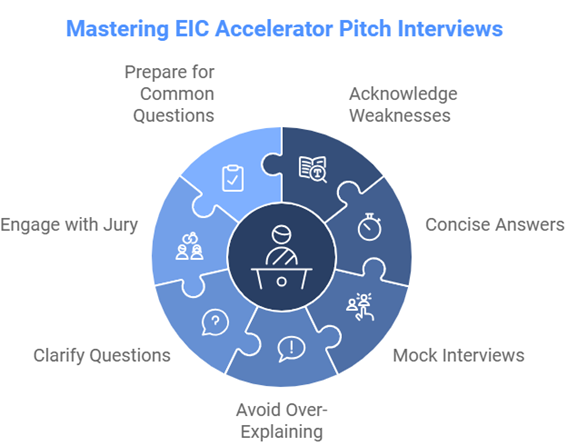
1. Know Your Project’s Weaknesses
It’s easy to focus solely on your project’s strengths, but the jury is likely to raise concerns about potential weaknesses. Every project has them. Perhaps your product needs further refinement, or your market strategy could use more validation. The key is to acknowledge these weaknesses and be prepared with a well-thought-out response that demonstrates you have anticipated challenges and have a clear plan for addressing them. This shows maturity, transparency, and a thorough understanding of your project.
2. Prepare Short, Specific, and Quantified Answers
Time is of the essence during the pitch interview. With only 10 minutes to present your project and 35 minutes to answer questions, it is crucial to be clear and concise. Jury members will likely ask 3-5 questions each, so you will need to manage your time wisely and respond effectively. Here are some tips for crafting strong answers:
- Short: Limit your answers to one minute or less. Avoid rambling or giving unnecessary details.
- Specific: Be direct and focused. Answer the question at hand without diverging into unrelated topics.
- Quantified: Where possible, support your answers with hard data. This could be financial projections, market analysis, or product development milestones. Numbers provide clarity and credibility (e.g., “We plan to reduce production costs by 25% by the end of the first year”).
3. Practice with Mock Interviews
Preparation is key. The EIC Accelerator provides mock interview resources that simulate the experience with real questions. Practicing with these mock interviews allows you to refine your responses and get comfortable with the format. You can also tailor mock interviews to your specific sector (for instance, healthcare or energy) to ensure the questions align with the focus of your project. This practice will also help you hone your timing and delivery, ensuring your answers are both concise and impactful.
4. Don’t Over-Explain: Keep It Concise
In a pitch interview, less is often more. If the jury seems satisfied with your answer, avoid the temptation to provide additional information. Over-explaining can lead to confusion and may distract from your main points. The jury will likely have follow-up questions if they need more detail, so leave space for them to probe further. Being concise signals confidence and allows for more efficient interaction.
5. Clarify Unclear Questions
If you do not fully understand a question, it is better to ask the jury to clarify rather than guessing or answering incorrectly. There is no shame in requesting a second explanation. In fact, it shows that you are focused on giving an accurate and thoughtful response. Ensuring you understand the question fully allows you to respond more effectively and avoid miscommunication.
6. Stay Engaged with the Jury
Maintain eye contact with the jury while speaking. Engaging with them visually helps convey confidence and establishes a connection. Also, pay attention to their body language. If they seem satisfied with your answer, do not keep talking. On the other hand, if they cut you off, it is a sign that you have already addressed the question. Respect their cues, and let the conversation flow naturally.
7. Be Prepared for the most Common Questions
Finally, anticipate the types of questions the jury is likely to ask. Common topics include your project’s market potential, financial sustainability, scalability, and risk management strategies. Prepare clear, focused responses for each of these areas, and practice weaving numbers and data into your answers whenever possible. The jury will be looking for concrete evidence of your project’s viability and long-term potential.
By preparing in advance, practicing your pitch, and keeping your answers focused and data-driven, you will be well-positioned to impress the jury and increase your chances of securing EIC Accelerator funding.
The EIC Accelerator program is a unique opportunity to bring groundbreaking ideas to life. At Euro-Funding we have been helping companies at the interview stage for years and we know that good preparation can make the difference between getting the funding or not. By following these steps, you will prepare properly for the interview and be in a good position to impress the jury and increase your chances of success.
LATEST NEWS

Coordinating EU collaborative projects
Coordinating EU collaborative projects: when execution marks the difference Lucía Duque Teva( Project Manager European Funds )Settings Coordinating a European collaborative project goes far beyond convening meetings or collecting deliverables….

EU Added Value in LIFE Proposals
EU Added Value in LIFE Proposals Fernando Gómez( Technical Manager – European Funds )Fernando Gómez es Technical Manager – EU Projects en Euro-Funding desde 2020, con experiencia coordinando propuestas europeas…
The vision of the EAIC on the future European budget
The vision of the EAIC on the future European budget Marie Latour( European Affairs Director )Actualmente, como Director de Asuntos Europeos en Euro-Funding, cuento con más de 14 años de…